





Celeste Christmas Stocking | PetiteKnit | Printed Pattern
products.product.pickup_availability.unavailable
Free UK delivery over £80
Dispatched within 1 working day
Real knitters, real advice
Ask us anything, we knit it all
Curated with care
Ethically sourced brands we knit ourselves
Rated 5 stars by 480+ customers
Verified reviews via Judge.me
Overview
Celeste Christmas Stocking
Knitting Pattern | PetiteKnit | Experienced Intermediate
Click on the KWM Yarn Suggestions tab for our recommended yarns in store.
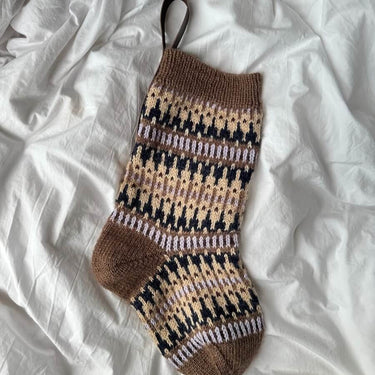
The Celeste Christmas Stocking is worked from the leg to the toe. The top rib edge, heel and toe are worked in one solid colour, while the rest of the stocking is worked in a stranded knitting pattern in 5 different colours. The heel is shaped using short rows.
Please note that stranded knitting often needs to be worked on a needle that’s 0.5-1 mm [½ to a whole needle size] larger to maintain the same gauge as the solid stockinette stitch sections. For this reason, you need to work a swatch in both the stranded pattern and in solid stockinette stitch before starting your stocking.
You are purchasing a printed knitting pattern, not the item itself.
Size: one size
Gauge: 22 sts x 32 rows = 10 x 10 cm [4 x 4 inches] in stockinette stitch on a 3 mm [US2½] needle; 22 sts x 24 rows = 10 x 10 cm [4 x 4 inches] in pattern on a 4 mm [US6] needle
Needles: Circular needles: 3 mm [US2½] and 4 mm [US6] / 40 cm [16 inches]; Double-pointed needles: 3 mm [US2½]
Materials: Pattern colour 1 (rib edge, heel and toe): approx. 57 g Peer Gynt by Sandnes Garn (50 g = 91 m [98 yds]); Pattern colour 2: approx. 12 g; Pattern colour 3: approx. 37 g; Pattern colour 4: approx. 8 g; Pattern colour 5: approx. 22 g Peer Gynt by Sandnes Garn (50 g = 91 m [98 yds])
Leather strap: 45 cm, 2 Chicago screws
Difficulty: ★ ★ ★ ★ (4 out of 5)
See the classification of difficulty in the level of difficulty tab.
The brown Celeste Christmas Stocking is knitted in Peer Gynt by Sandnes Garn in the colours Cacao nibs [3091], Shell melange [2710], Muskat melange [3070], Perfect purple [5012] and Night sky [5591].
KWM Yarn suggestions
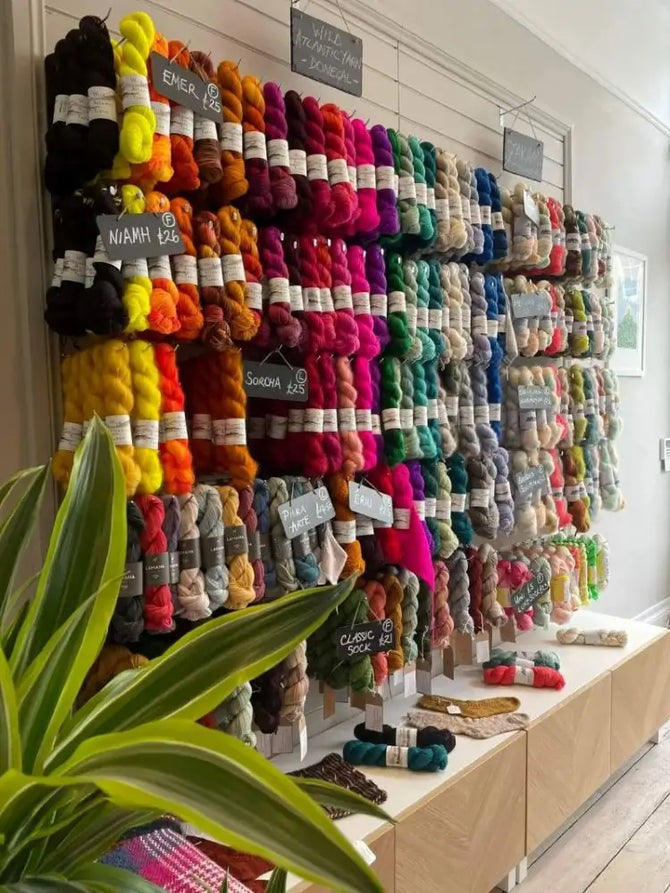
Here are some of our recommended yarns available at Knit With Me for this pattern. Please get in touch for more suggestions or any other questions via the contact form.
Wool trace minis (number of balls depends on colour)
Videos
Jacquard / Fair Isle:
Skp:
K2tog:
Heel:
German short rows:
Toe:
Kitchener stitch:
About PetiteKnit
Behind the name PetiteKnit you find Mette Wendelboe Okkels, who develops knitting patterns for both women, men and children of all ages.
PetiteKnit was established in 2016 and since then more than 300 patterns of varying difficulty have been released and more are still coming. Besides patterns, PetiteKnit develops and sells products that are almost essential when knitting.
When and where did you start knitting?
My grandmother taught me to knit when I was 6 years old, and I have knitted ever since. However, it wasn’t until I was on maternity leave with my first daughter, I started developing my own designs and knitting larger pieces for myself as well. I met a group of older women who talked and knitted, and they taught me a lot about techniques and ways to knit.
What has made you work professionally with knitting?
Although it wasn’t they who taught me to knit, I think it was my father and my mother who inspired me to make my creative side my profession. They have both been self-employed all my life, so the idea of working for myself and creating something that was my own has really always been there – even though it took almost 10 years of studying medicine to realize it.
I find the process of knitting both inspiring and relaxing, and it is often while holding the needles that I come up with ideas on how to use a technique or how the form should be. I also really enjoy communicating knitting, explaining how to move from one step to another, calculating all the sizes and details and writing it down in a manner that is easy to follow.
What has studying medicine meant for your work as a knitwear designer?
My 10 years of studying medicine have meant a lot for my way of writing patterns. The scientific method of writing an article is in many ways the same as that of writing a pattern. My supervisor at university told me that a methodology section should be written so that anyone else would be able to do the same. In many ways writing a pattern is exactly the same. I write down each step in a way that anyone with a knowledge of the techniques should be able to arrive at the same result.
Difficulty Guide
At PetiteKnit you will find patterns with varying levels of difficulty. Each pattern has been given a level of difficulty ranging from 1 to 5 stars, where 1 star is given to the patterns that are the easiest for beginners to knit and 5 stars are given to the patterns with the most advanced techniques aimed at experienced knitters.
1 ★ – BEGINNER
The patterns in this category have been written for absolute beginner knitters. Here you only need to know the most basic techniques to be able to knit the pattern.
2 ★★ – EXPERIENCED BEGINNER
The patterns in this category are slightly more difficult than the beginner patterns, but they are still easy to take on. The patterns are for knitters that have completed their first project and feel confident in reading a pattern.
3 ★★★ – INTERMEDIATE
The patterns in this category require that you have experience with and feel confident in using the basic knitting techniques, as the patterns contain more advanced techniques for example for casting on, picking up and knitting stitches or working short rows.
4 ★★★★ – EXPERIENCED INTERMEDIATE
The patterns in this category require that you are an experienced knitter and can keep an overview of a pattern. You may need to keep track of multiple elements at the same time – for example you may need to work a charted pattern while working shaping at the same time.
5 ★★★★★ – ADVANCED
The patterns in this category require that you are a seasoned knitter who knows how to keep an overview of a pattern, knows how to place a chart and work shaping based on the instructions given in the pattern.