



PetiteKnit was established in 2016 and since then more than 300 patterns of varying difficulty have been released and more are still coming. Besides patterns, PetiteKnit develops and sells products that are almost essential when knitting.


Poppy Tee | PetiteKnit | Printed Pattern
£6.50
/
Tax included.
Shipping calculated at checkout.
products.product.pickup_availability.unavailable
Free UK delivery over £80
Dispatched within 1 working day
Real knitters, real advice
Ask us anything, we knit it all
Curated with care
Ethically sourced brands we knit ourselves
Rated 5 stars by 480+ customers
Verified reviews via Judge.me
Overview
Poppy Tee
Knitting Pattern | PetiteKnit | Experienced Intermediate
Click on the KWM Yarn Suggestions tab for our recommended yarns in store.
The Poppy Tee is worked from the top down. First the top part of the back yoke is worked with increases, then the shoulders are worked from stitches that are picked up and knitted along the slanting sides at the back yoke. Stitches are then picked up and knitted along the sides of the shoulders and the rest of the yoke is worked together on the circular needle, first back and forth and then in the round. The body is worked in the round on a circular needle, and the sleeves are worked in the round on double-pointed needles or on a circular needle using the Magic Loop technique. At the end a folded neck edge with built in double knitting is worked.
You are purchasing a printed knitting pattern, not the item itself.
Begin by working a swatch to determine which needle size you need to achieve the correct gauge. Wash and block the swatch before taking any measurements. Be aware that if you are knitting in the recommended yarn, the knitted fabric can grow when washed – this is the reason it is important that you wash your swatch before measuring your gauge.
Size guide
The Poppy Tee is designed to have approx. 5 cm [2 inches] of positive ease, meaning it is designed to be approx. 5 cm [2 inches] larger in circumference than your bust measurement. The sizes XS (S) M (L) XL (2XL) 3XL (4XL) 5XL are designed to fit a bust circumference of 80-85 (85-90) 90-95 (95-100) 100-110 (110-120) 120-130 (130-140) 140-150 cm [31½-33½ (33½-35½) 35½-37½ (37½-39½) 39½-43¼ (43¼-47¼) 47¼-51¼ (51¼-55) 55-59 inches]. The measurements for the finished garment are given on the first page of the pattern. Please note that these measurements are only achieved if the correct gauge is obtained. Measure yourself before beginning your project, to determine which size will fit you the best. For example, if you measure 90 cm [35½ inches] around your bust (or around the widest part of your upper body) you should knit a size S. A size S sweater has a bust circumference of 96 cm [37¾ inches] which in the given example would give you 6 cm [2¼ inches] of positive ease.
Sizes: XS (S) M (L) XL (2XL) 3XL (4XL) 5XL
Bust circumference: 90 (96) 101 (106) 115 (125) 136 (146) 155 cm [35½ (37¾) 39¾ (41¾) 45¼ (49¼) 53½ (57½) 61 inches]
Length: 52 (54) 56 (58) 59 (60) 63 (66) 70 cm [20½ (21¼) 22 (22¾) 23¼ (23½) 24¾ (26) 27½ inches] measured mid back excl. neck edge
Gauge: 23 sts x 32 rows = 10 x 10 cm [4 x 4 inches] in stockinette stitch on 3.5 mm [US4] needles
Needles: Circular needles: 3.5 mm [US4] / 60, 80 and/or 100 cm [24, 32 and/or 40 inches] and 3 mm [US2½] / 40, 80 and/or 100 cm [16, 32 and/or 40 inches]; Double-pointed needles: 3.5 mm [US4] and 3 mm [US2½] (unless you use the Magic Loop technique)
Materials: Suggestion 1: 175 (200) 200-225 (225) 250 (275) 300 (325) 350 g Cashmere Classic by Cardiff Cashmere (25 g = 112 m [120 yds]) or Cashmere Premium by Lang Yarns (25 g = 115 m [126 yds])
Suggestion 2: 200 (200) 200-250 (250) 250 (300) 300 (300) 350 g Sunday by Sandnes Garn (50 g = 235 m [257 yds]) or Merino by Knitting for Olive (50 g = 250 m [273 yds]) held together with 100 (100-125) 125 (150) 150 (175) 175 (175) 200 g Tynn Silk Mohair by Sandnes Garn (25 g = 212 m [232 yds]) or Soft Silk Mohair by Knitting for Olive (25 g = 225 m [246 yds])
Suggestion 3: 175-200 (200) 225 (250) 275 (300) 325 (350) 375 g Tynn Silk Mohair by Sandnes Garn (25 g = 212 m [232 yds]) (with two strands of yarn held together)
Difficulty: ★ ★ ★ ★ (4 out of 5)
See the classification of difficulty in the level of difficulty tab.
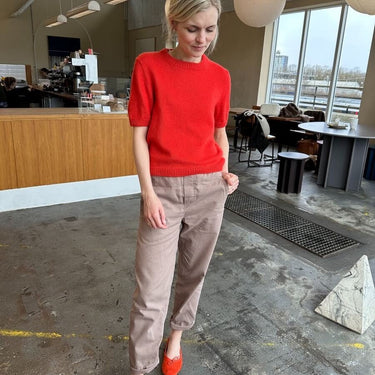
The red Poppy Tee is knitted in Cashmere Classic by Cardiff in the color Hermes [517].
The grey Poppy Tee is knitted Merino by Knitting for Olive in the color Lammegrå held together with Compatible Cashmere by Knitting for Olive in the color Lammegrå.
KWM Yarn suggestions
Here are some of our recommended yarns available at Knit With Me for this pattern. Please get in touch for more suggestions or any other questions via the contact form.
Option 1: Cardiff Cashmere Classic - held on its own
Option 2: Lamana Como - held on its own
Option 3: De Rerum Natura Alice - held on its own
Option 4: John Arbon Yarnadelic - held on its own
Other options: Lang Vaya
Videos
Begin:
Join the work:
M1R on the RS:
M1L on the RS:
M1L on the WS:
M1R on the WS:
Put sleeves to rest:
Italian bind-off:
Quick and easy italian bind-off:
Backwards loop method:
Avoid hole at startup on sleeve:
k2tog:
k2tog tbl:
Picking up stitches for neck edge:
Double knitting in the neck edge:
Knit down the neck edge:
About PetiteKnit
Behind the name PetiteKnit you find Mette Wendelboe Okkels, who develops knitting patterns for both women, men and children of all ages
When and where did you start knitting?
My grandmother taught me to knit when I was 6 years old, and I have knitted ever since. However, it wasn’t until I was on maternity leave with my first daughter, I started developing my own designs and knitting larger pieces for myself as well. I met a group of older women who talked and knitted, and they taught me a lot about techniques and ways to knit.
What has made you work professionally with knitting?
Although it wasn’t they who taught me to knit, I think it was my father and my mother who inspired me to make my creative side my profession. They have both been self-employed all my life, so the idea of working for myself and creating something that was my own has really always been there – even though it took almost 10 years of studying medicine to realize it.
That it is knitting I have chosen to work with, feels both very obvious and as a matter of many coincidences, because maybe it could have been some other creative craft. Knitting has the advantage that you can bring it everywhere. No matter where you are or almost what you are doing or if you only have 5 minutes, you can bring your knitting and knit even just a few rows or stitches. In that way, knitting has become part of who I am, and it feels wrong to leave my house without a project.
I find the process of knitting both inspiring and relaxing, and it is often while holding the needles that I come up with ideas on how to use a technique or how the form should be. I also really enjoy communicating knitting, explaining how to move from one step to another, calculating all the sizes and details and writing it down in a manner that is easy to follow.
Do you have a particular routine for working on new patterns?
When I start a new project it usually starts with an idea, either a vague idea of a color or shape or a more concrete idea of a construction or a technique used in a specific way. Then I start knitting for myself while taking notes along the way – this often entails a lot of unraveling as well since the idea often gets finalized while the stitches are on my needles. I like to challenge myself and the techniques. It is amazing how many different ways there are to make a raglan sweater. The basic construction is the same, but it all comes down to how the techniques are combined or used differently. Yarn can also make all the difference, since the same form looks different when you change up the yarn. The gauge and the structure can change the look of the finished piece.
I often find that construction is more interesting to work with than structure – although I have been fairly interested in structure lately as well.
After finalizing the form comes the work of calculating sizes and putting all my notes in order and into the form of my patterns. Sometimes this is straightforward, but sometimes this step really takes some work to finetune the details in all sizes and parts of the knitwear. This is also a challenging part, but writing the patterns and communicating the pattern in a way that is easy to follow is also a very satisfying part.
What has studying medicine meant for your work as a knitwear designer?
My 10 years of studying medicine have meant a lot for my way of writing patterns. The scientific method of writing an article is in many ways the same as that of writing a pattern. My supervisor at university told me that a methodology section should be written so that anyone else would be able to do the same. The level of information should neither be too high so as to interfere with the meaning, or too low so as not to be adequate. In many ways writing a pattern is exactly the same. I write down each step in a way that anyone with a knowledge of the techniques should be able to arrive at the same result.
This way of thinking about the instructions in a pattern has shaped the way I write patterns and also the way I design. There is no need to complicate steps that could follow each other naturally.
The years of medicine have also taught me to be thorough and to have a focus on all the intermediate calculations. I wouldn’t have been without those years, and I think I utilize many different skills from my studies.
What inspires you?
This is always one of the hardest questions to answer, because inspiration comes from everywhere. It can be a color, a shape, a woman passing me on the street. I try to be very open to impressions.
What is the most important thing to consider when developing new patterns?
A part of my motivation for knitting for myself has always been to knit something of just as high or higher quality than I could have bought. Both in the quality of the yarn I use and in the way the knitwear fits me. For this reason, the first thing I consider when designing a new piece, is that it has to be something I want to wear or use myself or see my family wearing.
When I knit, I like to challenge myself while at the same time keeping the flow of the knitting in mind. The flow is a hard thing to explain, but flow in knitting for me is when each step follows naturally and there are no unnecessary shifts like changing the yarn or having to stitch something together. There are few things more satisfying in terms of flow than knitting a raglan sweater.
I feel – and hope – that if the flow is right, then the pattern will also be easier to follow even if several complicated techniques are used.
What makes knitting so interesting?
Knitting is interesting for several reasons: The act of knitting is in itself akin to meditating and working with your hands and keeping the hands and mind occupied is good for you but knitting has the added benefit of having a product come out of it. This - to me - makes it more interesting than other equally meditative practices such as puzzles. It keeps me motivated while I de-stress. I think this is what drives so many to knit as well, that is, the pleasure of doing something that feels good but at the same time has a purpose.
What is the best thing about being able to knit yourself?
One of the best things about knitting is that the quality can be prioritized, and that you can have the final piece be just like you want it in terms of yarn, color, length and all those other details that you cannot buy the variety of in the stores. Small changes can make a big difference, and when you are knitting the piece yourself, you can make all those changes.
Having knitted something yourself – or having something knitted your you – makes it filled with so much meaning. There are many feelings in the hours it takes to knit.
What is the point that you consider the most important when knitting?
Personally, I think the most important thing when I knit is making an effort. Exactly because the process has a purpose, I want the piece I am knitting to be something I will actually enjoy wearing or using when it is finished. It’s the same reason I would rather unravel an almost finished sweater if I made a mistake earlier on or the fit isn’t exactly as it should be – and because the process is a much a part of the pleasure as the finished knitwear, it is okay to work on it for many hours rather than rush it and not be satisfied with the result.
Besides that, I value quality a lot. When I spend hours knitting, it feels good to use quality yarn and quality equipment.
Difficulty Guide
At PetiteKnit you will find patterns with varying levels of difficulty. Each pattern has been given a level of difficulty ranging from 1 to 5 stars, where 1 star is given to the patterns that are the easiest for beginners to knit and 5 stars are given to the patterns with the most advances techniques aimed at experienced knitted.
1 ★ – BEGINNER
The patterns in this category have been written for absolute beginner knitters. Here you only need to know the most basic techniques to be able to knit the pattern. The patterns are written using very beginner friendly language with no or very few abbreviations. Many of the patterns, especially the Novice series, have comprehensive videos that take you through and explain the steps in working the pattern.
You will meet the following techniques in the beginner category:
Cast on, knit, purl, knit through the back loop, decrease, increase, yarn over and standard bind-off.
2 ★★ – EXPERIENCED BEGINNER
The patterns in this category are slightly more difficult than the beginner patterns, but they are still easy to take on. The patterns are for knitters that have completed their first project and feel confident in reading a pattern.
In this category you will meet abbreviations. The abbreviations that are particular for this pattern will have explanations. There will be videos that take you through the techniques that are used in the pattern.
You will meet the following techniques in the experienced beginner category, as well as the techniques in the previous categories:
Knitting together a folded edge, buttonholes, simple texture patterns and picking up and knitting stitches
3 ★★★ – INTERMEDIATE
The patterns in this category require that you have experience with and feel confident in using the basic knitting techniques, as the patterns contain more advanced techniques for example for casting on, picking up and knitting stitches or working short rows. There will be videos that take you through the techniques that are used in the pattern.
You will meet the following techniques in the intermediate category, as well as the techniques in the previous categories:
Reading simple charts, Italian cast on, Italian bind off, Judy’s Magic Cast On, i-cord, simple double knitting, double knitting for Italian bind off, German Short Rows, texture patterns, simple finishing techniques, embroidery on knitting and knitting with more than one color at a time.
4 ★★★★ – EXPERIENCED INTERMEDIATE
The patterns in this category require that you are an experienced knitting and can keep an overview of a pattern. You may need to keep track of multiple elements at the same time – for example you may need to work a charted pattern while working shaping at the same time. There will be videos that take you through the techniques that are used in the pattern.
You will meet the following techniques in the experienced intermediate category, as well as the techniques in the previous categories:
Working a charted pattern, sewing in a zipper, double knitting and advances texture patterns like for example brioche knitting.
5 ★★★★★ – ADVANCED
The patterns in this category requires that you are a seasoned knitter who knows how to keep and overview of a pattern, knows how to place a chart and work shaping based on the instructions given in the pattern. There will be videos that take you through the techniques that are used in the pattern.
You will meet the following techniques in the advanced category, as well as the techniques in the previous categories:
Advanced double knitting for example along edges, collars and buttonholes, decreases/increases worked in pattern and short rows worked in a texture pattern.